Suicide Cleanup: Costs & Insurance
Decision-focused information about suicide cleanup scope variables, estimate comparison, documentation, and policy questions. Coverage depends on the triggering peril, policy language, limits, exclusions, deductible, and carrier review.
Posts on costs and insurance explain what shapes a suicide cleanup estimate. They also explain how coverage choices are usually made. Pricing depends on how much material must be removed and whether fluids reached the subfloor or the inside of walls. It depends on how much waste must be hauled. It also depends on whether odor control or return visits are needed. The articles avoid quoting prices, because every home and every policy is different. Instead, they help you read a written estimate line by line and notice vague items. They also explain why two providers may describe the same room in different ways. The goal is clarity, not pressure to decide fast.
Get an email reply about suicide cleanup
Send a short message to the follow-up inbox. A coordinator can reply by email. This form does not send emergency help; call 911 first if anyone is in danger.
Many homeowner and renter policies cover sudden damage to a property. Some families find that the cleanup is covered in part or in full. Others learn that limits or exclusions apply. Some find the policy belonged to the person who died and must be handled through the estate. These posts suggest ways to talk with an adjuster in a factual way. They explain which records to gather and how to ask for a written reason if a claim is questioned. They also cover options when insurance does not apply. You might ask about payment plans. You might check whether a state victim help program has any role in your case.
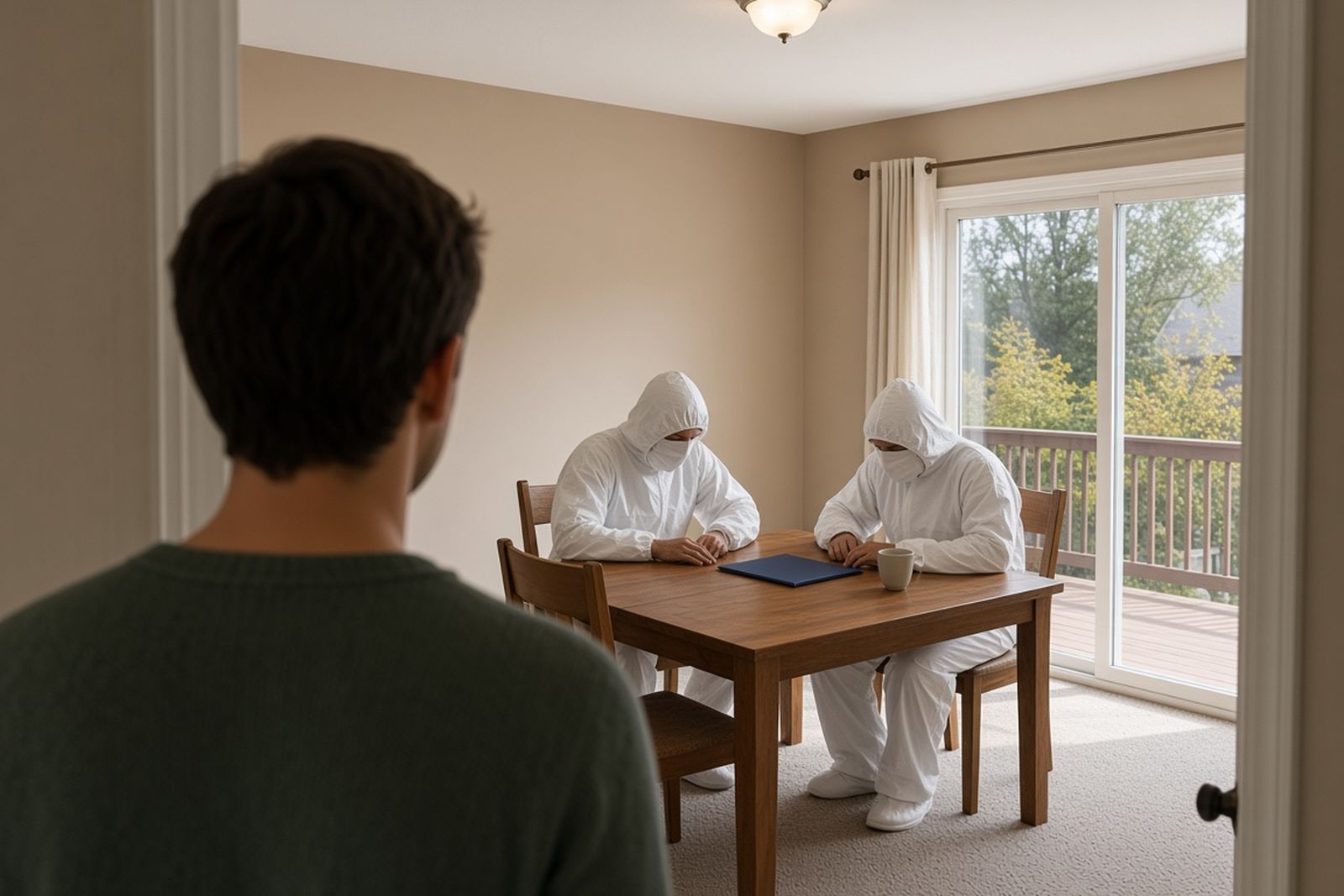
What Drives Suicide Cleanup Cost?
A calm explanation of what shapes the cost of cleanup after a suicide at home, from affected materials and timing to belongings, discretion and payment help.
The cost of cleanup after a suicide depends on how many surfaces and materials were affected, whether porous items like carpet or a mattress must be removed, how much time passed before the home was released, whether odor developed, and how much regulated waste is created. Requests to save personal items may add time. An on-site assessment and itemized written scope give you the real number.
Does Homeowners Insurance Cover Suicide Cleanup?
A gentle guide for families after a suicide at home: how homeowners and renters policies may respond to cleanup, what adjusters ask, and where to get support.
Many homeowners policies can cover part of the cleanup and repair after a suicide at home, but it is not guaranteed. Coverage turns on the policy's wording, whether damage fits a covered cause of loss, and how the insurer applies exclusions. Call the insurer early, ask what documentation it needs, and remember that life insurance is a separate policy with separate rules.

How to Compare Low and High Suicide Cleanup Bids
A gentle guide to comparing suicide cleanup bids after a loss: what a complete quote covers, where low bids fall short, and questions to ask without pressure.
To compare suicide cleanup bids, set them side by side and look at what each includes rather than the total alone. A complete quote covers a respectful assessment, containment, removal of affected materials, disinfection, waste disposal, handling of personal items, verification and a written summary. Ask how hidden damage will be handled, and choose a provider who explains everything patiently and never rushes you.
Sourced figures on costs & insurance
- $500 billion
CDC states that suicide costs Americans over $500 billion annually, and each prevented suicide saves over $10 million in societal and health care costs.
Read with care: Includes medical, work-loss, value-of-statistical-life and quality-of-life costs; not out-of-pocket family costs.
Source: CDC (2024)United States, annual societal cost estimate
- every 3 years
Hazmat employees must receive recurrent DOT training at least once every three years.
Read with care: Records must be kept for the prior three years plus 90 days after employment ends.
Source: DOT PHMSA (49 CFR via Cornell LII) (2024)United States, all hazmat employees
- 180 days
Facilities generating more than 100 kg but less than 1,000 kg of hazardous waste per month are Small Quantity Generators and may store it up to 180 days.
Read with care: Limit extends to 270 days when the disposal facility is over 200 miles away.
Source: EPA (2024)United States, RCRA generators
These figures are public research and agency data, not this network's own job records. Keep each number with its population, year and limits; none of them predicts cost, timing or outcome at a specific property.
What research has found
Findings from published studies of people and properties in situations like this one. They describe what researchers observed in a specific group; they are not predictions for your case.
Some relatives mistakenly believed police identification was compulsory for them.
Some parents regretting viewing described seeing a decomposed body.
Costs & Insurance: common questions
Should I wait for the insurer to approve the claim before scheduling cleanup?
Not always. Many policies expect you to take reasonable steps to prevent more damage. Waiting can let odor and contamination get worse. Tell the insurer right away. Ask whether it wants to inspect first, and keep every record. A provider can often record the conditions in detail so the adjuster can review them later.
Why do estimates from different providers vary so much?
Providers may judge how far fluids spread out of sight in different ways. Some include odor work and some leave it out. They may also handle waste through different haulers. Some list every step, while others group items together. Ask each company to explain what its estimate covers and what it leaves out. Compare the scopes, not just the totals.
Can a provider bill the insurance company directly?
Some providers will work directly with an insurer if the policyholder or estate representative allows it. Even then, it is still up to you to understand what the policy covers. Read any form that hands over claim rights or gives approval before you sign it. Ask what happens if the insurer pays less than the bill.
Is it normal for a suicide cleanup provider to ask for money up front?
Some providers ask for a partial payment before work begins, often to cover materials or to hold a crew on the schedule. Ask what the amount covers and whether it is refundable if plans change, and get the terms in writing. Be cautious of any company that wants the full amount before anyone has assessed the room or started the work.
Can cleanup costs be paid from the estate?
In many cases, cleanup of property owned by the person who died can be treated as an estate expense, but this depends on the estate's situation and local law. Talk with the executor or an estate attorney before paying. Keep all invoices and receipts organized. If the estate is not yet open, ask the provider whether they can wait for payment or accept an interim arrangement.
What if we find a lower price after signing with a provider?
Review your contract for cancellation terms before making any change. A lower price may not include the same scope, so compare carefully. If work has not started, you may be able to cancel, possibly with a fee. If it has, switching providers mid-job is usually disruptive. Discuss your concerns with your current provider first; they may be able to explain or adjust.
Are there programs that help families who cannot afford cleanup?
Some states offer victim help or payment programs. Local charities, faith groups, or groups for people who lost someone to suicide may also help in some cases. Who qualifies varies widely. A provider, social worker, or funeral director may know of local options. Ask a helper to look into these for you, so you do not have to make lots of calls while grieving.
Related community polls
Every count is a real visitor vote; nothing is seeded or padded. One vote per poll per device, and you can change your answer.
If you were coordinating cleanup after a suicide loss, who would you want to make the first call to a provider?
How important is it to you that a cleanup crew arrives in unmarked vehicles and plain clothing?
More on suicide cleanup
Suicide Cleanup services
Learn what cleanup after a suicide loss involves. See how scene release, approval, disinfecting, belongings, and records all work to protect your family.
Costs explained
What drives the price, published cost ranges, and how to read a written quote line by line.
Insurance and payment
Which policies may respond, how to document a claim, and what to do if coverage is denied.
Planning tools
Six short, private tools help you plan the first day, check risk, vet a provider, estimate cost, sort out a claim, and understand waste.
Community polls
See how other families handled privacy, insurance, staying home, and picking a provider after a suicide loss. Add your own view without giving your name.
Knowledge quiz
Check what you know about hazards, who can approve work, sealing off the room, disinfecting, waste, and records. This gentle quiz is for families and helpers.
Field guides
Step-by-step guides walk you through approval, privacy requests, insurance questions, and when to go back in after a suicide in a home or rental.