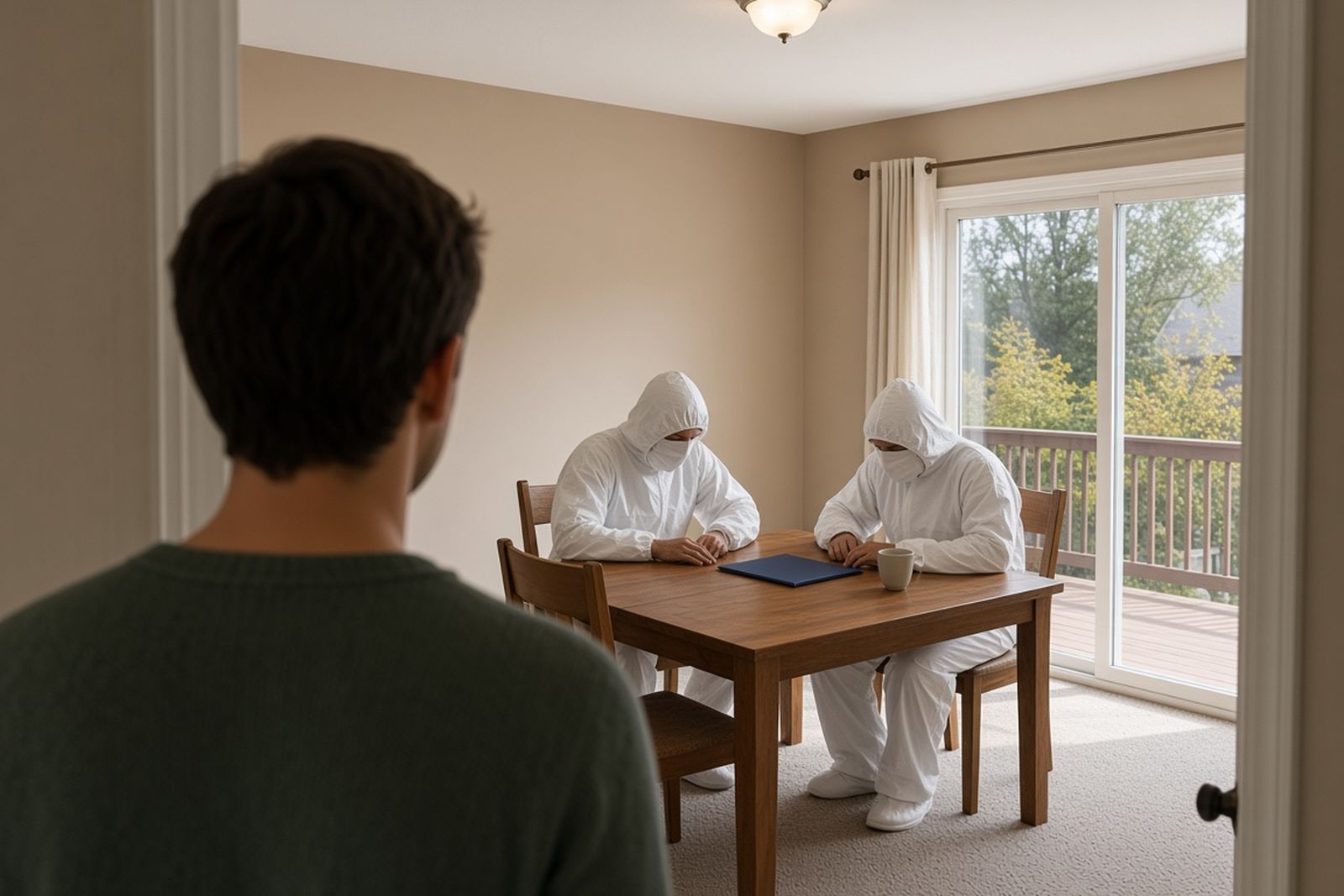
Short answer
The cleaning itself is similar wherever a suicide occurs, but the surrounding decisions are not. At home, the family usually decides and privacy centers on grief. In a business, a manager or owner authorizes work, employees and customers must be considered, work windows are tighter and records serve insurers and leadership. Both settings need discretion, careful handling of belongings and access to support.
The cleaning is the same; the setting is not
The core remediation work is largely the same. A trained crew inspects the affected area, removes porous materials that absorbed fluids, cleans and disinfects hard surfaces, packages regulated waste and documents what was done. Blood and other bodily fluids do not behave differently because a building is zoned for commerce.
What changes is almost everything around the work: who has authority to approve it, who needs to be informed, when the crew can be on site, what records are required and how the people affected are cared for. Those differences shape the experience as much as the cleaning does.
Understanding them ahead of time helps you choose the right provider and avoid decisions that add pain, confusion or cost.
Who makes the decisions in each setting?
In a private home, the decision-maker is usually the homeowner, a surviving spouse or partner, or the executor of the estate. If the person who died rented their home, the landlord controls the structure while the family generally decides about personal belongings.
In a commercial setting, the decision-maker is often a facility manager, business owner, human resources leader or corporate risk manager. If the business leases its space, the building owner or property manager may also need to approve work on floors, walls or systems. Some companies require legal or insurance review before any contractor enters.
In both cases, it helps to name one person who approves the scope, one person who communicates with the family and one person who receives updates. In a business, these might be three different people. At home, one trusted relative may do it all.
Privacy at home and at work
At home, privacy is about shielding a grieving family from neighbors' curiosity and from details they do not want to hear. Families often ask for unmarked vehicles, quiet arrivals and no conversation with anyone outside the household.
At a business, privacy has more layers. The person who died may have been an employee, a customer, a hotel guest or a stranger to the business. Their family's privacy still matters, but so does the privacy of coworkers who found them or were close to them. Leaders need to share enough to keep people safe and informed without spreading details or speculation.
A careful provider in a commercial setting will coordinate with whoever manages communication, avoid discussing the event with staff or customers and keep equipment and waste out of public view whenever possible.
There is also the question of the person's own belongings. At home, they are part of the family's life and are often left in place. At work, a desk, locker or company vehicle may hold personal items mixed with business property. Ask the provider to separate the two carefully, pack personal items for the family and return company property to a designated manager.
Why work windows and access matter more in commercial spaces
A family home can usually be closed to everyone except the crew for as long as needed. A store, office, hotel or warehouse may have ongoing operations, shared entrances, security systems and other tenants. The provider may need to work after hours, use a service entrance or coordinate with building security for elevator access.
Businesses sometimes feel pressure to reopen quickly. That pressure is understandable, but it should not shorten the work. The affected area should stay closed until remediation is complete and documented. Nearby areas can often reopen sooner if the provider sets up proper containment and a clear barrier.
It helps to agree in writing on which areas are closed, which can operate and what condition must be met before the affected area returns to use.
Hotels, apartment complexes with shared amenities and retail spaces with public restrooms raise another concern: neighboring rooms or areas that customers might enter. Ask the provider to check adjoining spaces and shared ventilation, and to tell you plainly whether those areas can stay open.
Can employees help clean up after a suicide at work?
Employees who are not trained and equipped for bloodborne pathogen exposure should not be asked to clean the scene. Asking untrained staff to help can expose them to physical hazards and deep emotional harm.
Most businesses outside health care and cleanup have not set up a bloodborne pathogens program for general staff, which is one more reason to bring in a qualified provider.
Staff can still help in other ways, such as securing the area, redirecting foot traffic or gathering the name of the provider's contact. Keep their role away from the scene itself.
Records and insurance in each setting
Homeowners usually need a clear scope, photos and invoice for their insurer, and sometimes for an estate attorney. Families often prefer that photos go directly to the insurer rather than to them.
Businesses may need more. A commercial policy, a landlord, a corporate risk department or an auditor may each ask for the scope, change approvals, disinfectant details, waste disposal records and a statement of when the area was cleared for reuse. Some organizations also keep an internal incident file.
In either setting, coverage depends on the policy wording, and no provider can guarantee an insurer's decision. Ask the provider to prepare documentation that is complete but not graphic, so it can be shared with the people who need it.
- Written scope tied to photographed findings
- Change orders with approval dates
- Disinfectant product and label contact time
- Waste disposal records
- Statement of when the area was cleared for use
Two settings, one kind of loss: an illustration
Consider two hypothetical cases. In the first, a woman dies by suicide in the basement of her family's home. Her husband asks his brother to handle the cleanup. The brother signs the authorization, arranges for the crew to arrive after the children leave for their grandparents' house and asks that her sweater and journal be set aside. The work is done in one quiet stretch, and the family receives a report through the brother.
In the second, an employee dies by suicide in a small office after hours, and a coworker finds him the next morning. The office manager closes the suite, calls the building's property manager and the company's insurer and hires a provider approved by both. The crew works overnight through the service entrance. Leadership tells staff that a colleague has died, offers time off and brings in grief counselors through the employee assistance program. Personal items from his desk are packed for his family.
Both scenarios are invented. The cleaning is nearly identical, but the coordination could hardly be more different.
What support should people receive afterward?
At home, support usually centers on the family, including children, and on anyone who found the person. Suicide loss survivor groups, grief counselors and faith communities can all help.
At work, support needs to reach a wider group. Coworkers, supervisors, security staff and customers who witnessed something may all be affected. Many organizations follow a postvention plan that includes a respectful announcement, access to counseling and flexibility for people who need time. Research by Cerel and colleagues published in 2018 estimated that each suicide death exposes about 135 people who knew the person, which is a reminder of how far the impact can reach.
Wherever the loss occurred, anyone struggling can call or text 988 to reach the 988 Suicide and Crisis Lifeline. Sharing that number openly, at home or at work, is a simple act of care.
Choosing a provider for your setting
Ask any provider whether they have worked in settings like yours. A company experienced with family homes will understand quiet arrivals and belongings. A company experienced with businesses will understand after-hours access, security coordination and more detailed records. Many providers do both well.
Ask how they will communicate, who on their team will be your contact and how they protect the privacy of the person who died and the people left behind. The right provider will make those answers feel natural, not rehearsed.
For a business, it is worth choosing and vetting a provider before anything happens. Keeping a short list of qualified companies, with confirmed insurance and a named contact, means no one has to search online in a moment of shock. Homeowners rarely plan this way, which is why a calm checklist and a trusted helper matter so much for families.
Whichever setting you are in, ask for the scope in writing before work begins and make sure it names who can approve changes. That single step protects a family's budget and a company's records alike.