Short answer
Neither a local company nor a national brand is automatically better for suicide cleanup. What matters is who will actually come to your home, how they are trained and insured, whether work is subcontracted, how discreet they are, who hauls the waste, what the written scope covers and who is responsible if something needs fixing later. Ask every provider the same questions and compare the answers.
Why the local-versus-national question comes up
When you search for help after a suicide, the results are usually a mix of small local companies and national brands with polished websites and toll-free numbers. Some local companies say they are better because they are part of your community. Some national brands say they are better because of their size and standards.
Both claims can be true, and both can be marketing. The label on the website tells you little about the people who will actually walk into your loved one's room. That is the part that matters most, and it is something you can find out by asking.
If comparing providers feels like too much right now, give this article to the relative or friend who is helping you. The questions below can be asked in a few short phone calls.
Who will actually come to my home?
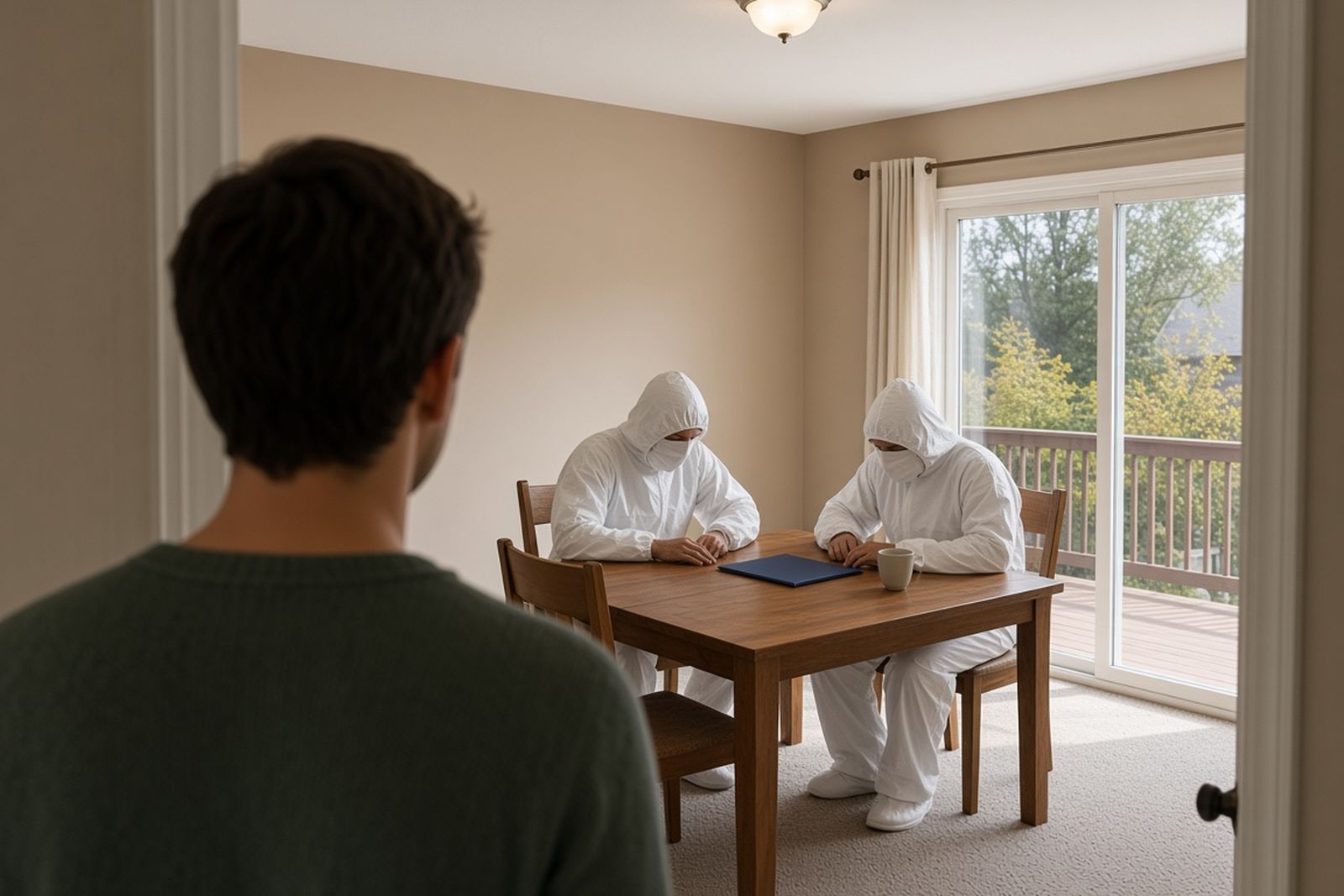
This is the single most important question. Many national brands operate through franchises, licensed affiliates or subcontracted crews. When you call a national number, the job may be handed to a local business that carries the brand name, or to an independent company the brand works with.
That is not necessarily a problem. A well-run franchise or subcontractor can do excellent work. But you deserve to know the name of the business that will perform the work, where the crew is based and who supervises them.
Local companies can subcontract too, especially during busy periods or for specialized tasks such as HVAC cleaning or flooring removal. Ask them the same question. A trustworthy provider will answer directly and put it in writing.
It also helps to know that these calls do not require you to describe what happened. A provider needs the address, the type of room, the flooring and when the home was released. You can say that you would rather not discuss details, and a good company will respect that immediately.
Training and insurance compared
Training requirements come from the work, not the size of the company. Crews who may be exposed to blood should be covered by their employer's bloodborne pathogen program. Ask any provider how their crew is trained, how often and whether records are kept.
Insurance should be verified directly, not assumed from a logo. Ask for a certificate of liability insurance naming the business that will perform the work. If a subcontractor is involved, ask for theirs too. Workers' compensation coverage for the crew is another reasonable question.
Some companies describe certifications or memberships. Ask what each one involves and how you could confirm it. Your state health or environmental agency can tell you whether your area requires any specific license or registration for this work.
- Name of the business that will perform the work
- Where the crew is based and who supervises on site
- How bloodborne pathogen training is delivered and recorded
- Certificate of liability insurance for the performing business
- Whether any part of the job is subcontracted, and to whom
- Name of the licensed waste hauler
Does a local company offer more privacy, or less?
Privacy is one of the less obvious differences. In a small town, a local crew may include people who know your family, your neighbors or your loved one. For some families, that familiarity is comforting. For others, it is painful, and they would rather work with people they will never see again.
A national brand's local franchise may be staffed by people from the same community anyway, so the brand name alone does not settle the question. If privacy matters to you, ask directly whether the crew lives nearby and whether you can request staff who do not know your family.
Either kind of provider should use unmarked vehicles on request, avoid discussing the job with anyone outside the approved contacts and keep all records confidential. Ask how they handle that.
Availability and arrival
National call centers are often available around the clock, which can be reassuring when you are calling late at night. But answering the phone quickly is not the same as having a crew nearby. Ask when a supervisor could actually arrive and where they would be coming from.
Local companies may have fewer staff but shorter travel distances. Some are small enough that the owner answers the phone and comes to the home personally. Ask what happens if they are already on another job.
In most suicide cleanups, a few hours rarely changes the outcome, and taking time to choose well is worth it. If there is an urgent concern, such as fluid reaching a downstairs ceiling, tell the provider so they can prioritize containment.
Local knowledge can matter in quieter ways too. A provider familiar with your area may know which waste facilities accept regulated waste, how the local health department handles questions and which grief resources exist nearby. A national brand's local operator may know all of this as well; ask either one what they know about your community.
Comparing estimates and scopes
Estimates are only comparable when they describe the same work. One company may include removing the carpet pad and sealing the subfloor, while another lists those as possible add-ons. One may include packing belongings from the room, while another charges separately. A lower number can simply mean a smaller scope.
Ask each provider for a written scope that lists affected areas, what will be removed, what will be cleaned and disinfected, how belongings will be handled, how waste will be disposed of and what is excluded. Then put the scopes side by side, or ask your helper to do it.
National brands sometimes use standardized pricing systems, while local companies may price each job individually. Neither approach is better by default. What matters is whether the method is explained clearly and whether you know how changes will be approved and billed if hidden contamination is found.
Be careful with any provider who gives a firm price over the phone without seeing the home or photos, or who refuses to put the scope in writing. Suicide cleanup often reveals conditions that cannot be seen at first glance, and an honest provider will say so.
Who is responsible if something needs fixing later?
Sometimes a faint odor returns weeks after cleanup, or a flooring installer finds staining that was missed. When that happens, you need to know who will come back and at whose cost.
With a national brand, ask whether the brand itself or the local operator stands behind the work, and how complaints are handled. With a local company, ask about their policy for return visits. In both cases, get the answer in writing as part of the scope or contract.
Ask who keeps the records, too. If you need a copy of the final report for an insurer or a sale months later, you should know whom to call.
Ask, as well, what the provider will do if you are unhappy with any part of the work. A clear, calm answer, such as a return visit at no charge for items within the original scope, is a good sign regardless of the company's size.
What matters more than local or national
A clear written scope, respectful communication, careful handling of belongings, proper disposal and complete documentation matter far more than the company's size. So does how you feel after talking with them. If a provider rushes you, pressures you to sign immediately or will not answer basic questions, keep looking.
Trust your sense of how each provider treats you. The company that listens, answers plainly and does not rush you is often the one that will treat your loved one's home and belongings with the same care.
Grief after a suicide can make every decision feel heavy. If you or anyone in your family is struggling, call or text 988 to reach the 988 Suicide and Crisis Lifeline, any time of day or night.